Artificial intelligence is becoming an increasingly common part of marketing, from content creation and advertising optimization to customer personalization and campaign analysis. As businesses explore these applications, AI marketing statistics offer insight into adoption rates, investment trends, productivity gains, and reported performance.
However, widespread adoption does not necessarily mean that companies have fully integrated AI into their operations or achieved consistent returns. Our team at The Marketing Signal gathered the following AI marketing statistics that examine how marketers use AI, where businesses are investing, and what research reveals about its opportunities and challenges.
Key AI Marketing Statistics
- Salesforce reported that 87% of marketers used generative AI in at least one recurring workflow in Q1 2026, up from 51% in Q1 2024.
- Grand View Research estimated the global AI marketing market at $27 billion in 2025 and projected it would reach $194.8 billion by 2033.
- Omnibound found that 77% of marketers using generative AI applied it to creative development.
- HubSpot reported an average of 6.1 hours saved per marketer each week through AI tools in its 2026 research.
- A McKinsey survey reported 3.2x ROI for AI-assisted content drafting and 2.7x for personalization engines.
- According to research from BCG, it is reported that 74% of companies struggle to achieve and scale value from AI initiatives.
AI Marketing Market Size and Growth Statistics
Market research firms provide different estimates of the AI marketing market’s size and future growth. These figures should be interpreted within each report’s methodology rather than treated as directly interchangeable forecasts.
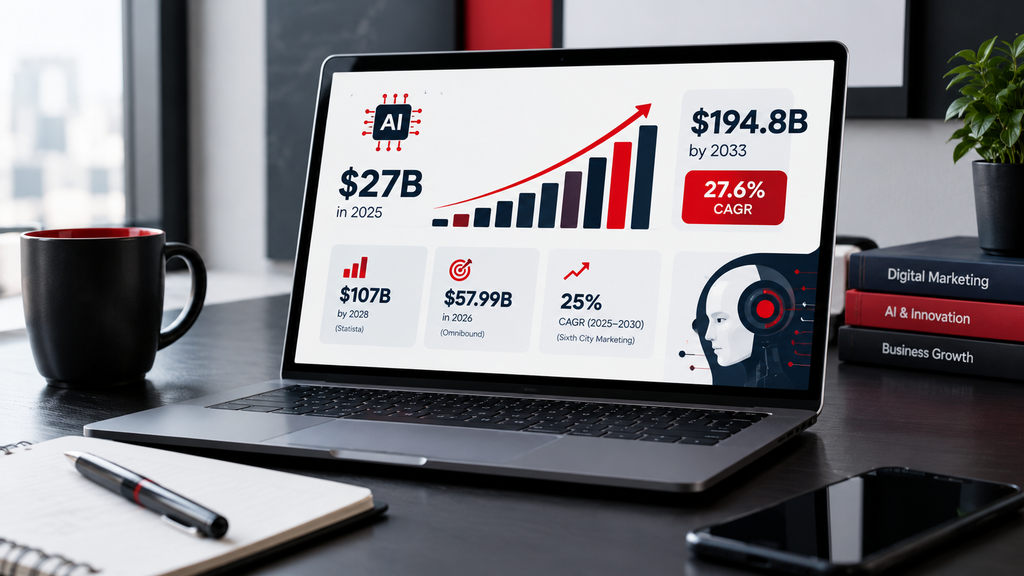
- The global AI marketing market was estimated at $27 billion in 2025, according to Grand View Research.
- Grand View Research projected the market would reach $194.8 billion by 2033, with a compound annual growth rate (CAGR) of 27.6% from 2026 to 2033. (Grand View Research)
- The market was projected to reach $107 billion by 2028 in the Statista estimate.
- It is reported a global AI marketing market estimate of $57.99 billion in 2026, with a projected CAGR of 37.2% from 2018 to 2026. (Omnibound)
- AI marketing spending was projected to grow at a 25% CAGR from 2025 to 2030. (Sixth City Marketing)
The estimates differ considerably, including for overlapping years. Each should therefore remain tied to its original research publisher and stated timeframe.
AI Adoption Statistics Among Marketers
AI use has expanded across marketing teams, although survey results vary according to how adoption is defined. Using AI in one recurring task, for example, is different from integrating it across an entire marketing operation.
- 87% of marketers used generative AI in at least one recurring workflow in Q1 2026, compared with 76% in Q1 2025 and 51% in Q1 2024. (Salesforce)
- 94% of enterprise marketing teams with 250 or more marketers had adopted generative AI in recurring workflows by Q1 2026, according to the same Salesforce research.
- 88% of organizations regularly used AI in at least one business function in 2025, up from 78% in 2024. (Shopify)
- 67% of small and medium-sized businesses reportedly use AI in marketing. (Sixth City Marketing)
- 92% of companies planned to invest in generative AI tools over the following three years. (Sixth City Marketing)
These findings indicate growing adoption, but they measure different populations and activities. Broader business adoption should not be interpreted as the percentage of marketing teams using AI specifically.
AI Marketing Content Creation and SEO Statistics
Content creation is one of the most frequently reported applications of generative AI. Marketers use these tools to brainstorm ideas, summarize information, prepare drafts, and increase the volume of content they can produce.
- 77% of marketers using generative AI applied it to creative development. (Omnibound)
- 62% of marketers used AI for brainstorming topics, 53% for summarizing content, and 44% for writing drafts. (Omnibound)
- Companies using AI reportedly published 42% more content per month. (Averi)
- 74% of newly created webpages contained AI content in some form. (Ahrefs)
- 65% of businesses reportedly experienced improved SEO performance from AI marketing tools. (Semrush)
- 91% of pages cited in Google AI Overviews reportedly contained some AI-generated content. (Ahrefs)
These statistics describe reported usage, content prevalence, and perceived SEO outcomes. They do not establish that AI-generated content automatically ranks better or that increasing publication volume guarantees organic traffic growth. According to our AI SEO statistics, AI is also reshaping organic click-through rates, referral traffic, and how websites gain visibility in AI-powered search results.
AI Advertising, Email Marketing, and Social Media Statistics
AI applications extend beyond written content. Businesses also use AI for audience targeting, campaign optimization, automated recommendations, and customer interactions across digital channels.
- AI-powered email campaigns can increase open rates by up to 41% in certain industries. (Sixth City Marketing)
- 26% of B2B marketers using chatbots reported a 10–20% increase in leads. (Sixth City Marketing)
- AI-driven PPC bid management was reported to reduce wasted advertising spend by approximately 37% and increase advertising ROI by around 50%. (Zebracat)
- Facebook’s AI recommendations reportedly increased Reels watch time by 15%. (Sixth City Marketing)
- 30% of media agencies, brands, and publishers had fully integrated AI across the media campaign lifecycle. (Omnibound)
- 67% of marketers expected AI to help provide more personalized customer experiences. (Adobe)
The results cover different applications and study designs. They should be treated as reported findings rather than guaranteed improvements for every advertising campaign or business.
AI Marketing Productivity and Time-Saving Statistics
Reducing the time required for repetitive tasks is another commonly reported benefit of AI. The amount of time saved varies depending on the task, the tools used, and how frequently marketers rely on them.
- Marketers saved an average of 6.1 hours per week through AI tools (Hubspot)
- Senior marketing practitioners reportedly saved 8–10 hours per week using AI. (Omnibound)
- 83% of marketers using AI reported a direct productivity increase. (Shopify)
- 53% of marketers reported that generative AI improved speed to market. (Omnibound)
- AI’s potential productivity impact has been estimated at $4.4 trillion in value to the global economy. (McKinsey)
These figures measure different outcomes, including self-reported time savings, perceived productivity improvements, and estimated economic potential. The $4.4 trillion figure is a broad economic estimate, not revenue generated by marketing teams alone.
AI Marketing ROI and Campaign Performance Statistics
Beyond adoption and efficiency, marketers are interested in whether AI can improve campaign outcomes and generate measurable business value. The available figures include application-level ROI estimates and reported comparisons between AI-driven and non-AI campaigns.
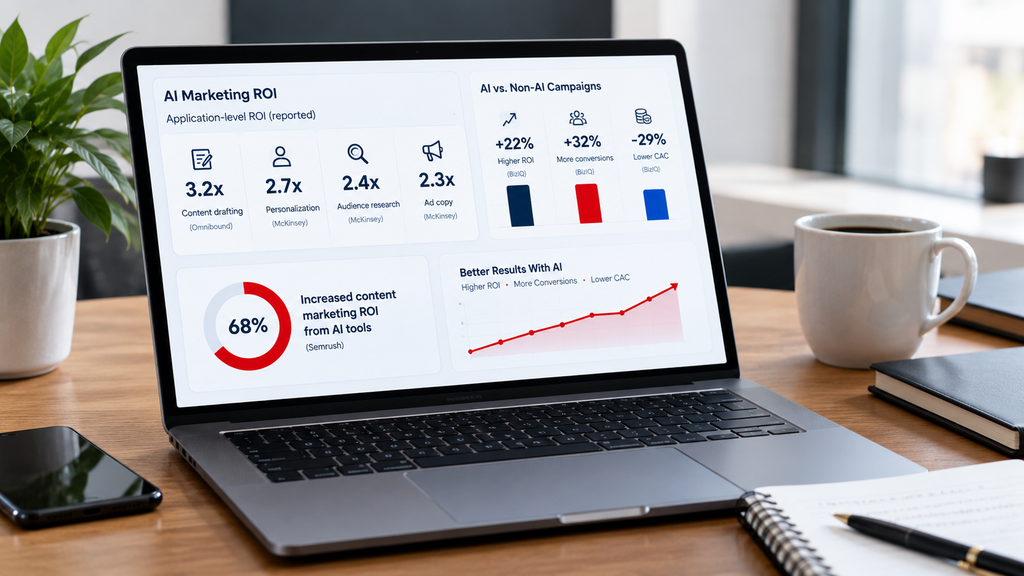
- AI-assisted content drafting reportedly delivered 3.2x ROI, the highest among the AI marketing applications (Omnibound)
- Personalization engines reportedly delivered 2.7x ROI, followed by audience research at 2.4x and ad copy at 2.3x. (McKinsey)
- AI-driven campaigns reportedly achieved 22% higher ROI than non-AI campaigns. (BizIQ)
- AI-driven campaigns reportedly generated 32% more conversions in the same analysis. (BizIQ)
- Customer acquisition costs were reportedly 29% lower for AI-driven campaigns in that analysis. (BizIQ)
- 68% of businesses reported increased content marketing ROI from AI tools. (Semrush)
Source 5 notes that McKinsey’s application-level ROI figures are based on survey responses rather than controlled experiments. They reflect reported returns and should not be interpreted as independently verified financial outcomes for every company.
AI Marketing Investment, Challenges, and Consumer Trust
Businesses are increasing their investment in AI, but implementation difficulties, skills gaps, and concerns about accuracy and trust remain important parts of the picture.
- 71% of CMOs planned to invest at least $10 million annually in AI between 2025 and 2027. (Sixth City Marketing)
- 63% of CMOs planned to increase AI marketing spending further. (Searchlab)
- AI tools and infrastructure accounted for 19% of marketing budgets (Searchlab)
- 74% of companies reportedly struggle to achieve and scale value from AI initiatives. (The Rank Masters)
- Only 6–30% of marketing organizations were reported to have fully integrated AI across their workflows. (BizIQ)
- 53% of consumers reportedly distrust AI-powered search results. (Shopify)
- 60% of marketing experts who had used generative AI content worried about potential brand harm related to bias, plagiarism, or misaligned values. (Sixth City Marketing)
The figures highlight a distinction between adopting AI tools and integrating them effectively. Investment and experimentation can grow quickly, while organizations still face challenges involving training, workflow design, human review, and trust.
Conclusion
AI marketing statistics show that artificial intelligence is becoming a regular part of marketing workflows, particularly in content creation, campaign optimization, and personalization. The supplied research also reports time savings, increased content production, and potential performance improvements.
However, adoption rates and market forecasts vary by source, while reported productivity and ROI figures do not guarantee the same results for every business. The most useful takeaway is to evaluate AI not only by how many teams use it, but also by how effectively they integrate it, measure outcomes, and maintain quality and consumer trust.