Artificial intelligence is changing how people discover information through search engines. Google AI Overviews and other AI-powered search experiences can answer questions directly in search results, potentially reducing clicks to websites and changing how businesses measure organic visibility. AI SEO statistics help explain these changes through data on click-through rates, organic traffic, AI citations, and search optimization practices.
However, the effects of AI search vary by platform, industry, and research methodology. Our team at The Marketing Signal gathered the following AI SEO statistics to examine the available evidence, distinguish findings from different studies, and explore how AI is influencing search performance.
Key AI SEO Statistics
- Google users clicked a traditional search result in 8% of visits involving an AI summary, compared with 15% of visits without one.
- Only 1% of visits involving an AI summary resulted in a click on a link cited within that summary.
- The first organic result experienced a reported 58% reduction in click-through rate when an AI Overview appeared.
- AI referral traffic grew by 527% across 19 Google Analytics 4 properties when comparing January to May 2024 with January to May 2025.
- AI referrals accounted for an average of 1.08% of total website traffic across 13,770 domains.
- 86% of SEO professionals surveyed by Aira reported integrating AI into their workflows.
- 43% of respondents in a survey reported implementing generative engine optimization (GEO) strategies.
AI Overviews and AI Search Statistics
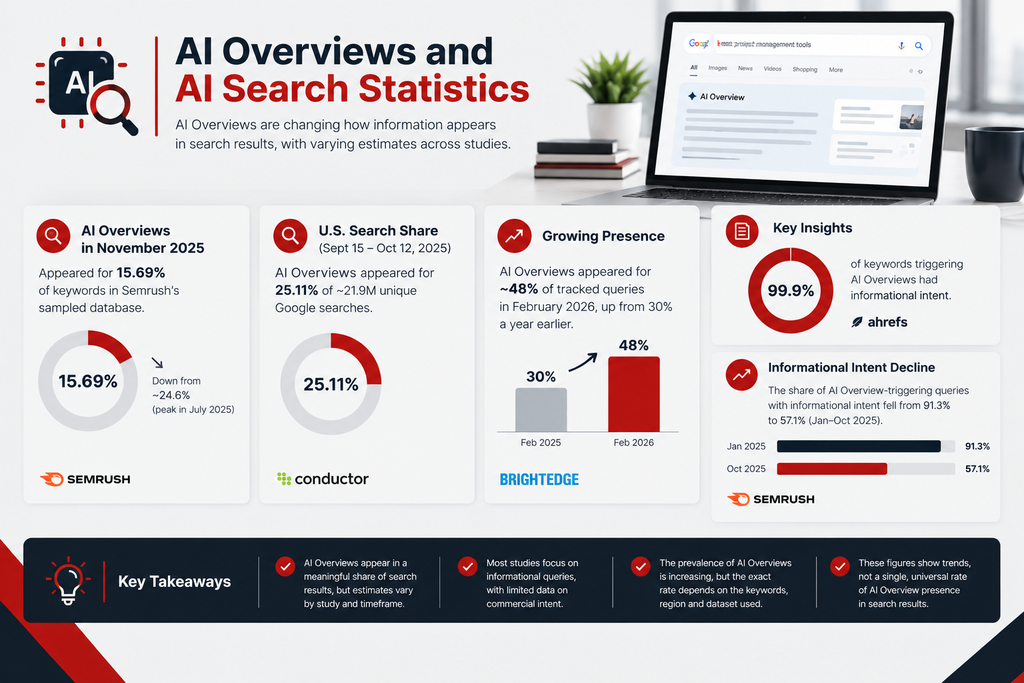
AI Overviews are changing the presentation of Google search results, but estimates of their prevalence vary across studies. The reported percentages depend on the keywords examined, the research period, and the dataset used.
- AI Overviews appeared for 15.69% of keywords in Semrush’s sampled database in November 2025, following a reported peak of approximately 24.6% in July 2025. (Semrush)
- AI Overviews appeared for 25.11% of approximately 21.9 million unique Google searches examined in a Conductor analysis covering September 15 to October 12, 2025, in the United States. (Conductor)
- AI Overviews appeared for approximately 48% of BrightEdge’s tracked queries in February 2026, up from 30% a year earlier. (BrightEdge)
- 99.9% of keywords triggering AI Overviews had informational intent in Ahrefs’ research. (SeoProfy)
- The informational share of queries triggering AI Overviews fell from 91.3% in January 2025 to 57.1% in October 2025 in Semrush’s study. (Semrush)
These estimates should not be treated as directly interchangeable. The studies examined different keyword samples and periods, and their findings do not establish one universal rate of AI Overview prevalence.
AI SEO Statistics on Organic Click-Through Rates
AI-generated summaries can answer questions before users visit a website. Several studies have examined how their presence relates to clicks on traditional organic search results and cited sources.
- Traditional search-result links were clicked in 8% of visits featuring an AI summary, compared with 15% of visits without one. (Pew Research Center)
- Only 1% of visits involving an AI summary resulted in a click on a link cited inside that summary. (Pew Research Center)
- 26% of browsing sessions involving an AI summary ended after the search visit, compared with 16% of sessions without an AI summary. (Pew Research Center)
- The click-through rate of the first organic result fell by 58% when an AI Overview appeared, according to an analysis of 300,000 keywords. (Ahrefs)
- Organic click-through rates for queries featuring AI Overviews declined from 1.76% in June 2024 to 0.61% in September 2025 across a study examining 25.1 million impressions and 42 organizations. (Seer Interactive)
The findings measure different outcomes and use different methodologies. They indicate an association between AI summaries and fewer clicks to traditional results, but they do not prove that AI Overviews alone caused every observed decline.
AI Search Statistics on Organic Traffic and Referrals
AI referral traffic has grown rapidly in some datasets, although its share of total website traffic remains relatively small in the studies provided. Growth rates and traffic shares measure different things and should be considered separately.
- AI and large language model referral traffic increased by 527% when comparing January to May 2024 with January to May 2025 across 19 Google Analytics 4 properties. (Omnibound AI)
- AI referrals accounted for an average of 1.08% of total website traffic across 13,770 domains and 3.3 billion sessions. (Position Digital)
- AI referral traffic represented approximately 0.24% of total web traffic in Ahrefs’ April 2026 estimate. (Ahrefs)
- The median publisher experienced a 10% year-over-year organic traffic decline in the first half of 2025, according to the Search Engine Journal report cited in the supplied research. (Search Engine Journal)
- Visitors referred by AI platforms converted at 4.4 times the rate of traditional organic visitors across more than 500 high-value topics in Semrush’s analysis. (Semrush)
These statistics describe different datasets and timeframes. The reported conversion comparison also does not mean AI visitors will convert at the same rate for every website or industry.
AI Citations, Google Rankings, and Search Visibility
AI search introduces another dimension of SEO visibility: whether a website’s content is selected as a source in an AI-generated answer. Research has examined the relationship between traditional Google rankings and AI citations, with results varying across studies.
- 17% of AI Overview citations came from pages in Google’s traditional organic top 10, according to BrightEdge’s research. (SeoProfy)
- 38% of AI Overview citations came from pages ranking in the organic top 10 in Ahrefs’ March 2026 research. (GoodFirms)
- 97% of AI Overview cases included at least one cited source from a page ranking within Google’s organic top 20. (SeoProfy)
- 43.2% of pages ranking first on Google were cited by ChatGPT in AirOps’ research. These pages were reportedly 3.5 times more likely to be cited than pages outside Google’s top 20. (AirOps)
- Brands were reportedly 6.5 times more likely to be cited through third-party sources than through their own domains in an AirOps study. (AirOps)
The percentages measure different aspects of citation visibility. For example, the share of citations coming from top-10 pages is not equivalent to the share of AI Overviews containing at least one source from the top 20. The findings should therefore remain tied to their original studies.
AI-Generated Content and SEO Statistics
AI-assisted content is increasingly common in online publishing, but its presence in search results does not automatically demonstrate that it improves rankings. The available research examines how frequently AI-generated content appears and whether its use is associated with organic visibility.
- 74% of newly published webpages contained some AI-generated content in Ahrefs’ analysis of more than 900,000 webpages published in April 2025. (GoodFirms, citing Ahrefs)
- 17.3% of results in Google’s top 20 contained AI-generated content. (AIOSEO)
- Purely AI-generated content ranked first in 9% of analyzed cases, compared with 80% for human-written content. (Semrush)
These findings use different samples and definitions of AI-generated content, so their percentages should not be combined.
They also do not establish that AI-generated content performs better than human-written content. The presence of AI-assisted material in search results is a measure of prevalence, not proof of a ranking advantage.
Content Structure and AI Citation Statistics
Beyond whether content contains AI-generated material, some studies have examined the characteristics of pages cited in AI-generated answers. The findings cover article structure, factual coverage, and the placement of information within a page.
- 44.2% of large language model citations reportedly came from the first 30% of a page’s text, compared with 31.1% from the middle section and 24.7% from the final third. (GoodFirms)
- Articles cited in AI Overviews reportedly covered 62% more facts than articles that were not cited in one study. (SurferSEO)
- In an early AirOps analysis, content containing five to seven statistics had a 20% higher likelihood of receiving ChatGPT citations. (GoodFirms)
- Pages with three comparison tables reportedly earned 25.7% more ChatGPT citations. (GoodFirms)
- Wix reported that 45.48% of citations for informational queries came from articles, while 40.86% of citations for commercial queries came from listicles. (Position Digital)
These results offer potential directions for further testing, but they should not be interpreted as guaranteed optimization formulas.
The studies use different datasets and methods, and a reported association between content structure and citations does not prove that changing a page’s format will produce the same result elsewhere.
AI Adoption and SEO Optimization Statistics
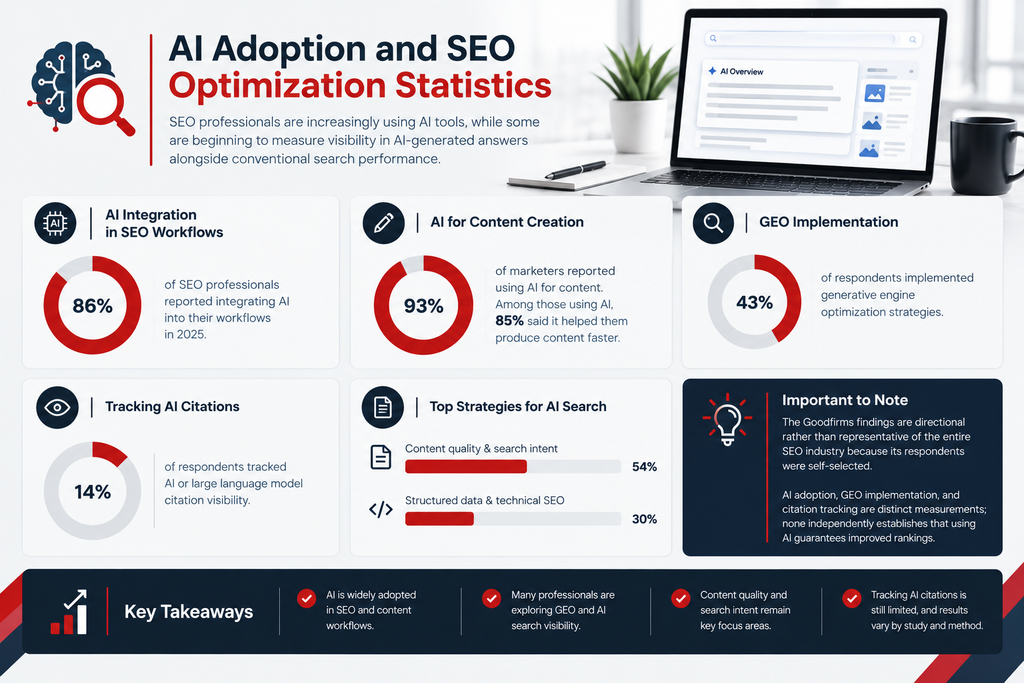
SEO professionals are increasingly using AI tools, while some are beginning to measure visibility in AI-generated answers alongside conventional search performance.
- 86% of SEO professionals surveyed by Aira reported integrating AI into their workflows in its 2025 State of SEO research, which surveyed 2,500 respondents. (SQ Magazine)
- 93% of marketers reported using AI for content. Among respondents using AI, 85% said it helped them produce content faster. (Position Digital)
- 43% of respondents in a Goodfirms survey of more than 100 SEO and marketing professionals reported implementing generative engine optimization strategies. (Goodfirms)
- Only 14% of Goodfirms survey respondents said they tracked AI or large language model citation visibility. (Goodfirms)
- 54% of Goodfirms survey respondents identified content quality and search intent as strategies for adapting to AI search. (Goodfirms)
- 30% of respondents in the same survey reported using structured data and technical SEO as part of their approach. (Goodfirms)
The Goodfirms findings are directional rather than representative of the entire SEO industry because its respondents were self-selected.
AI adoption, GEO implementation, and citation tracking are distinct measurements; none independently establishes that using AI guarantees improved rankings.
Conclusion
AI SEO statistics show that artificial intelligence is changing organic click behavior, referral traffic, and the way websites appear in search experiences. Research reports lower click-through rates when AI summaries appear, rapid growth in AI referrals, and varying relationships between traditional rankings and AI citations.
The findings also show that AI-generated content appears in search results and that some content characteristics are associated with AI citations. These observations do not guarantee ranking improvements or citation visibility. For a broader look at how artificial intelligence is influencing marketing beyond search, explore our AI marketing statistics covering key data and trends for 2026.
Evaluating traditional organic metrics alongside AI-related visibility and referrals provides a more complete picture of how search is evolving in 2026.